
Everything you need to know about unconscious bias in hiring.
Unconscious bias in hiring refers to unconscious attitudes that many of us hold, whether we know it or not. It’s a snap judgement based on the associations our brain forms automatically. Our brain is amazing at being able to process and store information, which is why it can form associations in the blink of an eye.
According to a National Bureau of Economic Research study, a resume with a traditionally white-sounding name gets disproportionately more callbacks than a resume with an African American-sounding name.
How can bias affect the hiring process?
Bias can affect it at every stage. It is possible for bias to affect both ends of the hiring process, from putting out job posts to handing over the offer. For instance:
In the job description: Gendered language or any other language that can put off potential candidates can affect the number of diverse candidates that apply.
While screening resumes: There are many unconscious biases that can come into play while screening a resume, such as names and where a candidate studied or worked before.
During interviews: The majority of hiring biases occur during interviews, according to studies. This can include:
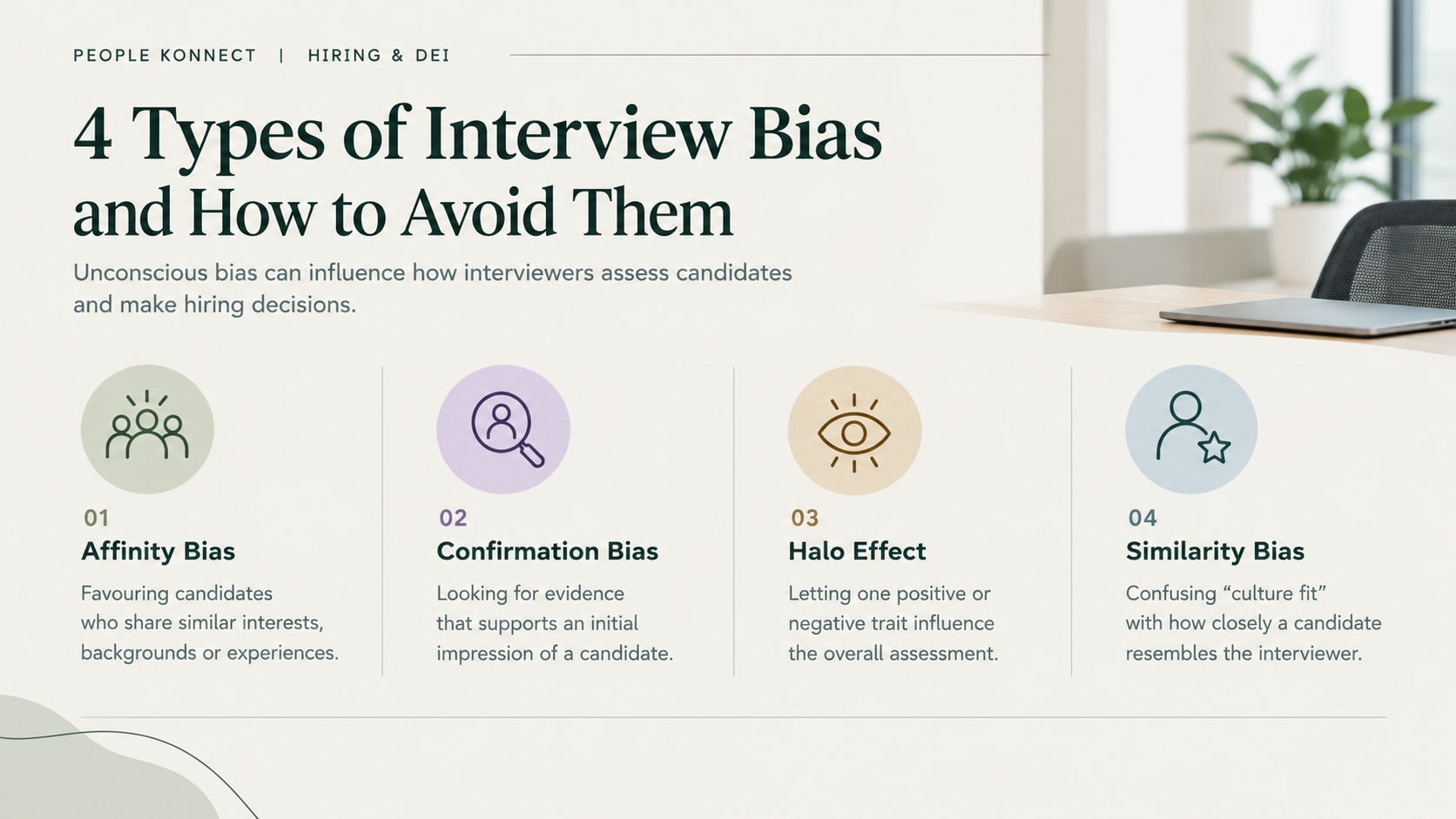
- Affinity bias: Feeling more favourable towards someone because they share similar characteristics with you.
- Confirmation bias: Having a certain perception of a candidate from the start and asking questions to prove it.
- Halo effect: Letting one good or bad attribute overshadow the entire interview.
- Similarity-to-self “culture fit”: Using the phrase ‘culture fit’ during interviews and having the candidate respond to how ‘similar’ they are to you.
In final decision-making: Decisions like who gets the job offer and who doesn’t can be affected by snap decisions and unstructured feedback.
Why are unbiased hiring practices important?
Apart from catering to different groups of people, biased hiring practices can affect the creativity and retention rate of your workforce.
Hiring without bias can help you build a diverse and inclusive workplace, which can have a tremendous upside on your company’s innovation and profitability. Additionally, diverse and inclusive workplaces tend to fare better in court cases related to bias in the workplace.
How to conduct interviews with less bias.
Although it is impossible to completely eradicate unconscious bias from our brains, we can create hiring processes that reduce the possibility of snap decisions being the deciding factor in who gets hired or not. You must consider investing in the following proven steps to reduce the effects of unconscious bias in your company’s hiring process:
Blind resume screening
During the resume screening process, you should ensure that you do not have access to any information that could give you an unfair advantage. This could mean removing any personal details like the candidate’s name or photographs from the resume.
Diverse interview panel
Having multiple people on your interview panel helps the process stay objective and accountable. Different people will have different opinions, which will keep the candidate on their toes and help everyone notice if one of the interviewers has unconscious biases.
Scoring before feedback
Instead of providing feedback to the whole team about the candidate right away, have every member of the interview panel score the candidate based on objective criteria first.
A structured definition of a ‘culture fit’
There needs to be a more structured definition for what a ‘culture fit’ entails. ‘Culture fit’ should be defined based on a candidate’s attributes and behaviour in relation to a role, not on the interviewer’s personal preferences.
Why training can change the way people think.
Training can help people gain awareness of their own unconscious biases, as well as help them create better policies for hiring decisions.
When people are trained in DEI areas, they can understand why the suggested policy would affect their work area or why they should change the way they interact with others.
If you want to ensure that your team of recruiters and hiring managers can conduct successful interviews without the risks of unconscious bias, it’s best to train them in unconscious bias to complement the suggested policies mentioned above. When unconscious bias training is provided for all company members, it can improve the productivity of not just the hiring managers but other team members as well. That is the underlying concept for our DEI training for organisations at People Konnect. We offer highly engaging DEI training for employees that offers them solutions they can implement on the same day of training. Our DEI training for employees covers realistic scenarios related to hiring and managing diverse teams.
Moving forward.
Unconscious bias is part of being human, but it is a choice to let it have control over how we make hiring decisions. The companies that can attract the best talent have started to question how they can improve the people who are involved in the decision-making process. If you would like to make a difference in the hiring process at your organisation, reach out to the People Konnect team to learn more about our DEI training programmes for organisations.