The guide looks at the three primary formats, explains in which situations each one is most suitable, and provides a practical framework for making the decision. These are the formats that People Konnect provides for organisations of all sizes and work models.
Understanding the Three Formats
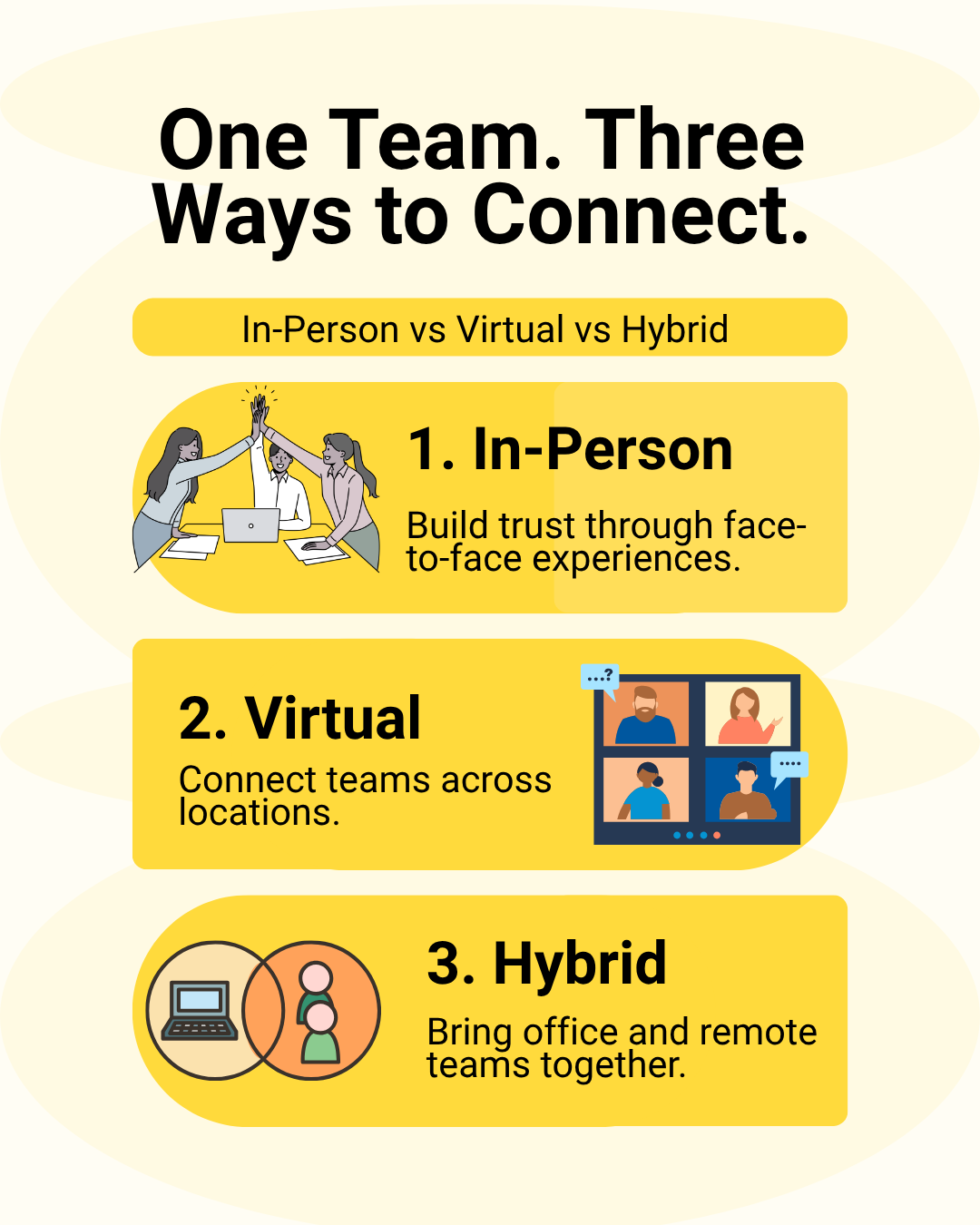
In-person activities gather employees in a physical environment, for example, at an offsite, a workshop, or a celebration. Virtual activities are carried out completely over the internet using video platforms and interactive tools. Hybrid activities combine the two methods so that some people take part in person while the rest join from a distance, all as part of one coordinated experience.
All formats have the potential to be successful; the appropriate one will vary according to the structure of your team, its objectives, and its culture.
In-Person Employee Engagement Activities for Employees: When Presence Matters
The best way of quickly establishing trust is through face-to-face interactions. Being in the same physical place promotes spontaneous conversation, picks up on body language, and allows for the more informal occasions which strengthen relationships.
Best suited for:
- Co-located teams based in the same city or office.
- Leadership offsites and strategy retreats.
- Onboarding cohorts and milestone celebrations.
- Teams recovering from change, restructuring, or low morale
The following points should be noted: holding in-person events involves greater budgetary requirements, the need to arrange a venue, and planning for travel. They may also exclude remote or part-time employees, leading to what is known as an ‘inside circle’ effect.
Virtual Employee Engagement Activities: Flexibility at Scale
Online courses have developed far beyond the stage of simple video conferences. Nowadays, virtual employee engagement events involve live trivia, collaborative challenges, wellness sessions, creative workshops, and guided discussions which aim to keep the participants actively involved rather than having them remain passive.
Best suited for:
- Remote and geographically dispersed teams.
- Organisations that need frequent, short engagement touchpoints.
- Companies seeking cost-efficient programmes across multiple locations.
- Teams that value convenience and inclusive access.
The following points should be noted: screen fatigue does exist and virtual sessions function most effectively when they are kept short, highly interactive, and professionally organised. Energy levels can drop rapidly in the absence of a competent host.
Virtual Team-Building Activities: Building Connection Without Proximity
It is often worried whether or not virtual team-building events can lead to real connections, but they can, as long as they are deliberately designed. For such sessions to be effective, it is necessary to have structured collaboration, definite aims, and chances for personal interaction, for example, through breakout rooms and team challenges.
Strong programmes focus on three elements:
- Instead of just observing, the participants take an active part.
- There is purposeful design since each activity is linked to a goal, for example communication, problem-solving, or recognition.
- A skilled facilitator is a trained host who keeps the atmosphere vibrant and makes sure that quieter voices are heard.
Hybrid Engagement: Bridging Office and Remote Teams
Hybrid working is now common in many organisations, and hybrid engagement deals with this by combining the personal aspect of face-to-face events with the scope of virtual team-building activities. The key issue here is equity since remote participants must never feel as though they are just spectators at an event taking place in person.
Best suited for:
- Companies with mixed office and remote staff.
- Town halls, award ceremonies, and company-wide events.
- Teams that meet in person occasionally but work apart day to day.
The following points should be noted: Because hybrid delivery requires thorough planning, dependable technology, and a range of activities which ensure that both groups take part on an equal footing, it provides the widest possible reach and the most inclusive experience when it is carried out effectively.
A Practical Framework for Choosing the Right Format
Five questions can guide your decision:
- Where does your team work? If most employees share a location, in-person works well. If they are dispersed, lean virtual. If you have a mix, consider a hybrid.
- What is your objective? Deep trust and relationship-building favour in-person. Regular, scalable connection favours virtual. Company-wide unity favours hybrids.
- What is your budget? Account for the full cost per participant, including venue, travel, and logistics. Virtual is typically the most predictable, while in-person and hybrid require more investment.
- How often do you need to engage? Quarterly or annual events suit in-person formats, while weekly or monthly touchpoints suit virtual ones.
- Can everyone participate equally? Whichever format you choose, every employee should be able to join comfortably and contribute on equal terms.
As a general rule, in-person suits deep relationship-building for co-located teams, virtual suits regular, scalable engagement for distributed teams, and hybrid suits mixed workforces that need to unify under one experience.
Combining Formats for Lasting Impact
Effective strategies usually don’t depend on just one format. A great many organizations arrange for a face-to-face meeting every quarter, together with monthly virtual employee engagement sessions, or hold hybrid company events in addition to smaller meetings at the team level. This kind of combination of activities maintains momentum between the big events and ensures that all employees remain connected.
Choosing a Partner That Adapts to Your Needs
It’s simpler to make decisions about format when your partner isn’t committed to a single method of delivery. Since People Konnect provides both in-person, virtual and hybrid experiences, the recommendations are based on your requirements rather than on a set of fixed options. Whether it’s planning and facilitation or technology and follow-up, the team assists you in choosing the most appropriate employee engagement activities for your employees and in designing them so that they produce measurable results, not just a pleasant afternoon.
Final Thoughts
There isn’t a single correct format; instead, you should choose the one that suits your people, your objectives, and your way of working. First, find out where your employees are and what they need in order to feel connected, and then select the format for delivering the message accordingly.
If you’re ready to find the best match, why not get in touch with People Konnect to talk over your team’s needs and look at engagement programmes that are tailored to your workforce?